


Safeguarding is a limiting judgement under the Education Inspection Framework. That single fact should shape how every school approaches its compliance. If Ofsted determines that safeguarding is ineffective at your school, your overall inspection outcome will be affected regardless of how strong your teaching, curriculum, or leadership may be.
This guide provides a comprehensive, practical checklist for meeting Ofsted’s safeguarding requirements in 2026, with a particular focus on the Single Central Record (SCR) and safer recruitment. Whether you’re preparing for an upcoming inspection or simply want to ensure your school’s safeguarding foundations are solid, this is the checklist you need.
How Ofsted Judges Safeguarding in 2026
Ofsted’s approach to safeguarding is binary: it is either met or not met. There is no partial pass, no “requires improvement” category, and no middle ground. Your school either meets its statutory safeguarding obligations in full, or it does not.
Inspectors assess safeguarding by looking at whether it is effective, embedded, and understood by staff and pupils. This is not just about paperwork. Ofsted wants to see that safeguarding is a living culture within your school, demonstrated through staff confidence, consistent reporting, timely action on concerns, and robust record-keeping.
That said, the Single Central Record remains one of the first documents inspectors request. It serves as the gateway to understanding whether your school’s safer recruitment processes are sound. A poorly maintained SCR immediately raises questions about the wider safeguarding culture.
The KCSIE 2025 Baseline: What Inspectors Measure Against
All Ofsted inspections in 2026 are benchmarked against Keeping Children Safe in Education (KCSIE) 2025, the statutory guidance that came into force on 1 September 2025. KCSIE 2025 is the document your staff should know, your governors should have read, and your SCR should reflect.
Key updates in KCSIE 2025 that affect your compliance include:
- Alternative provision safeguarding: Schools are now explicitly responsible for ensuring that any alternative provision setting they place pupils in has carried out appropriate safer recruitment checks. Written confirmation must be obtained and recorded.
- Online safety integration: Online safety is no longer treated as a standalone issue. It must be woven into your whole-school safeguarding approach, staff training, and the curriculum.
- Filtering and monitoring: Schools must have appropriate filtering and monitoring systems in place for their IT networks, and these systems must be reviewed regularly by the DSL.
- Low-level concerns framework: Schools should maintain a culture where staff feel comfortable reporting low-level concerns about colleagues, with clear procedures for recording and reviewing these concerns.
The Complete SCR Compliance Checklist
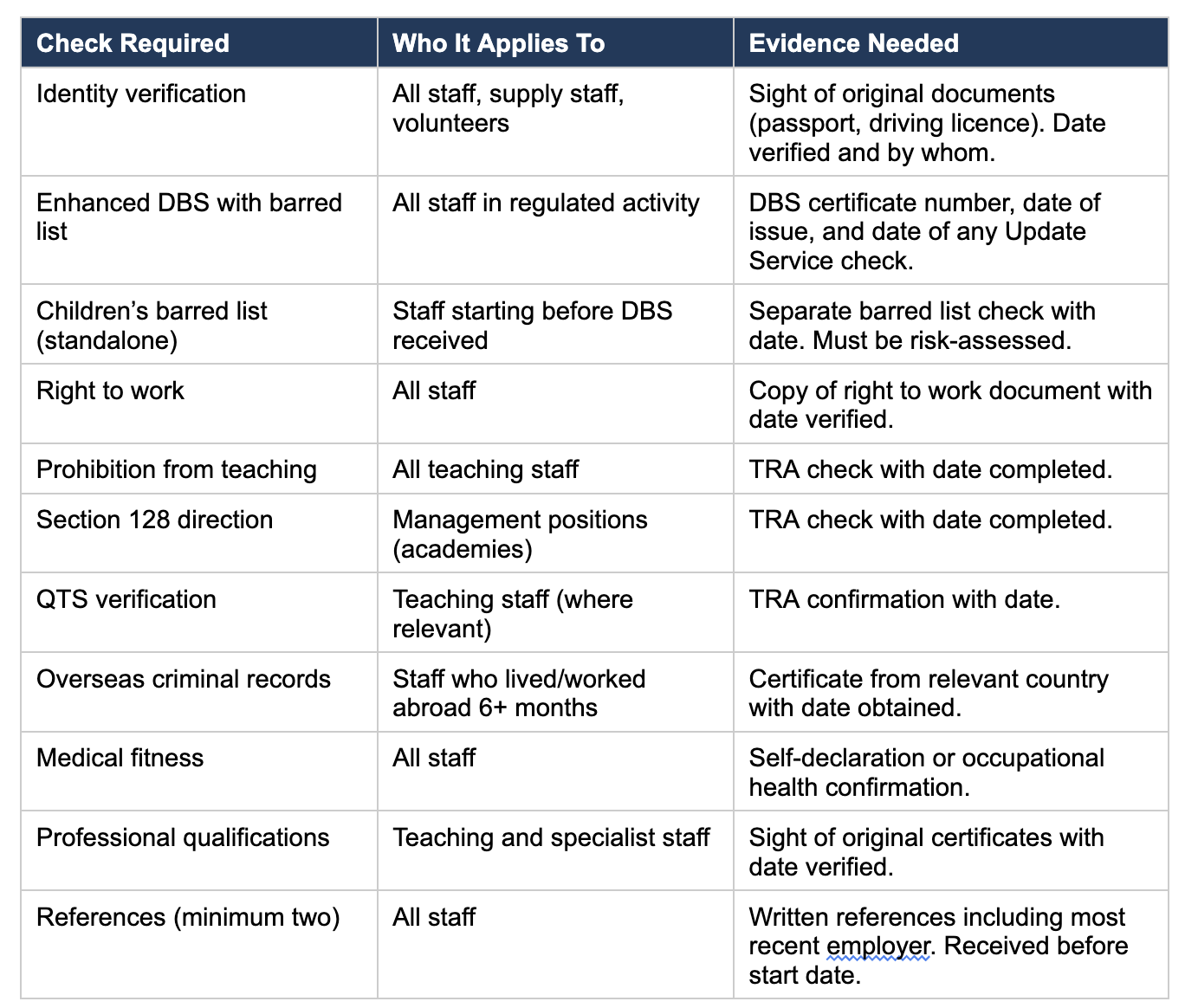
Your Single Central Record must demonstrate that every required pre-employment check has been completed, dated, and evidenced for every individual who works at your school. Use the table below as a working checklist:
Beyond the SCR: The Wider Safeguarding Checklist
While the SCR is critical, Ofsted’s safeguarding assessment goes well beyond it. Here are the additional areas inspectors will examine:
Safeguarding Policy and Procedures
- Your safeguarding and child protection policy is up to date, reflects KCSIE 2025, and has been approved by the governing body.
- The policy is published on your school website and accessible to parents.
- Staff know where to find the policy and can explain the key reporting procedures.
- The policy includes clear procedures for managing allegations against staff.
Designated Safeguarding Lead (DSL)
- A named DSL is in post with appropriate seniority and authority.
- The DSL has completed updated training within the last two years.
- A deputy DSL is designated to cover absences.
- The DSL maintains oversight of online safety, filtering, and monitoring.
- The DSL has capacity to carry out the role effectively and is not overburdened with other duties.
Staff Training and Awareness
- All staff have received safeguarding training that is regularly updated (at least annually).
- All staff have read and understood Part 1 of KCSIE 2025 (or the condensed Annex A for those not working directly with children).
- Staff can articulate the signs of abuse, neglect, and exploitation, and know how to report concerns.
- Training records are maintained and can be produced on request.
- Induction for new staff includes safeguarding training before or on their first day.
Governance and Oversight
- Governors receive regular safeguarding reports and challenge appropriately.
- A named safeguarding governor is in place and visits the school to review safeguarding practice.
- Governors have completed appropriate safeguarding training.
- The governing body reviews the SCR at least termly.
- There is an annual safeguarding audit presented to the full governing body.
Record-Keeping and Reporting
- Safeguarding concerns are recorded promptly using a secure system (such as CPOMS or My Concern).
- Records include clear chronologies showing actions taken and outcomes.
- Referrals to the local authority, police, or other agencies are documented with dates and responses.
- Low-level concerns about staff are recorded and reviewed for patterns.
- Information is shared appropriately when pupils transfer between schools.
Safer Recruitment: What Ofsted Expects in Practice
Safer recruitment is the process by which schools ensure that every adult who works with children has been properly vetted before they begin. Ofsted does not simply check that you have a safer recruitment policy on paper, inspectors want to see that it is followed consistently in practice.
Under KCSIE 2025, at least one member of every interview panel must have completed safer recruitment training. This training should be refreshed every five years as a minimum, though many schools now refresh it every three years as good practice. Inspectors may ask panel members directly about their training and how they apply safer recruitment principles during interviews.
Your school should also be able to demonstrate that job adverts include a statement about the school’s commitment to safeguarding, that application forms (not CVs alone) are used so that gaps in employment history can be identified and explored, and that references are obtained and scrutinised before a candidate is appointed, not afterwards.
One area that catches schools out is the handling of supply staff and contractors. When your school uses agency staff, you remain responsible for confirming that the agency has carried out the appropriate checks. This confirmation, including the date it was received and the name of the person who obtained it, must be recorded on your SCR. Simply assuming the agency has done its job is not sufficient.
Similarly, if your school engages self-employed contractors, visiting tutors, or peripatetic music teachers who have unsupervised access to pupils, the same pre-employment checks apply. These individuals must appear on your SCR with full records of the checks completed.
Online Safety and Digital Safeguarding
Online safety has become an increasingly prominent part of Ofsted’s safeguarding assessment. KCSIE 2025 makes clear that online safety should not be treated as a separate strand but should be integrated into your whole-school safeguarding approach.
Inspectors will want to see that your school has appropriate filtering and monitoring systems in place across all devices and networks used by pupils. Critically, these systems must be reviewed regularly, KCSIE recommends that the DSL maintains oversight and that the governing body receives reports on the effectiveness of filtering and monitoring arrangements.
Staff should also understand online risks relevant to their pupils, including online bullying, exposure to harmful content, online grooming, and the sharing of indecent images. This awareness should be reflected in your safeguarding training programme and in how your school responds to online incidents.
What Happens When Ofsted Finds Safeguarding Is Not Met
If an inspector determines that safeguarding is not effective, the consequences are serious and immediate. As a limiting judgement, a “not met” safeguarding outcome will typically result in an overall judgement of Inadequate, regardless of the quality of education, behaviour, or leadership in other areas.
This can trigger a range of consequences, including an Ofsted monitoring visit within a shortened timeframe, potential intervention by the local authority or Regional Director, reputational damage through the published inspection report, and in the most serious cases, consideration of formal intervention measures such as an academy order or changes to leadership.
It is worth noting that inspection reports are publicly available and frequently consulted by parents when choosing schools. A safeguarding finding does not just affect your next inspection, it can affect admissions, staff recruitment, and community confidence for years to come.
The message is clear: safeguarding compliance is non-negotiable. Schools that treat it as a box-ticking exercise, rather than an embedded culture, are the ones most likely to be caught out.
Top 5 Ofsted SCR Mistakes Schools Still Make
- Not recording dates for every check. A tick or “yes” without a date is not compliant. Inspectors will flag this immediately.
- Missing supply staff and agency workers. Schools must record confirmation that the agency has carried out the required checks, along with the date this confirmation was received.
- Failing to update after role changes. If a teacher becomes a head of department or deputy head, additional checks (such as Section 128) may be required. The SCR must reflect these changes.
- No record of who completed each check. The SCR must identify the person responsible for verifying each check, not just that it was done.
- Relying on an outdated spreadsheet. Spreadsheets without version control, audit trails, or automated reminders are increasingly seen as a safeguarding risk rather than a safeguarding tool.
How to Get Inspection-Ready
Preparing for an Ofsted inspection should not be a frantic last-minute exercise. The best schools are inspection-ready all the time, because their safeguarding practices are genuinely embedded rather than performed. Here are practical steps you can take today:
- Run a full SCR audit this term. Check every entry for completeness, accuracy, and supporting evidence.
- Test your staff. Can your receptionist, your NQT, and your teaching assistant all explain how to report a safeguarding concern? Ofsted will ask them.
- Review your safeguarding policy against KCSIE 2025. Ensure it reflects the latest statutory guidance, not last year’s version.
- Brief your governors. Make sure your safeguarding governor has visited recently and can speak knowledgeably about your school’s safeguarding practice.
- Check your digital safeguarding. Ensure filtering and monitoring systems are in place, reviewed, and documented.
- Consider dedicated SCR software. If you’re still using a spreadsheet, now is the time to consider whether a purpose-built system would give you greater confidence and reduce risk.
Take the Guesswork Out of Compliance
At School SCR, we help schools across England and Wales maintain a Single Central Record that is always inspection-ready. Our software automates checks, tracks expiry dates, and provides a complete audit trail, so you can focus on what matters most: keeping children safe.
If your school is preparing for an Ofsted inspection, or you simply want peace of mind that your SCR is compliant, book a free trial today.
Key Takeaways
- Safeguarding is a binary, limiting judgement, met or not met. There is no middle ground.
- Your SCR is one of the first things Ofsted requests. It must be complete, dated, and immediately accessible.
- KCSIE 2025 is the statutory baseline for all inspections in 2026. Ensure your policy, training, and SCR reflect it.
- Safeguarding is assessed as a culture, not just a checklist. Staff awareness and reporting confidence matter as much as paperwork.
- Regular auditing, governor oversight, and dedicated software are the hallmarks of schools that pass with confidence.
Disclaimer: This article is intended as general guidance and does not constitute legal advice. Schools should consult the latest Ofsted inspection framework and KCSIE guidance directly for the most up-to-date requirements.