


If you manage compliance at an independent school, the Single Central Record is no longer something you can afford to treat as a background administrative task. Under the latest ISI inspection framework, your SCR is now one of the very first things inspectors will ask to see, often within the first hour of arriving on site.
This guide breaks down exactly what ISI inspectors are looking for in 2026, what has changed, and what your school needs to do to stay compliant. Whether you’re a bursar, head of HR, or a member of the senior leadership team, this is essential reading before your next inspection.
What Is the Single Central Record and Why Does ISI Care?
The Single Central Record (SCR) is a statutory document that every school in England must maintain. It provides a centralised record of all pre-employment checks carried out on staff, supply staff, governors, volunteers, and anyone else who works in your school.
For independent schools inspected by the Independent Schools Inspectorate (ISI), the SCR sits at the heart of Part 4 of the Independent School Standards (ISSR), Suitability of Staff, Supply Staff and Proprietors. This part of the regulations sets out, in precise detail, the checks schools must complete to demonstrate that every adult with access to pupils has been properly vetted.
A failure to maintain a compliant SCR is not a minor administrative oversight. It is a regulatory failure that can result in your school being judged as not meeting the Independent School Standards, triggering an action plan, follow-up inspection, or in serious cases, referral to the Department for Education.
What Has Changed for 2026?
ISI has made several important changes to how it inspects the Single Central Record. These are not wholesale rewrites of the standards, but they represent a significant shift in inspection practice that every independent school needs to understand.
1. Early and Immediate SCR Review
The updated Operating Guide, effective from January 2026, now explicitly states that inspectors must review the SCR “as soon as possible at the start of the inspection.” In practice, this means your SCR will likely be requested within the first hour of an inspection visit. There is no time to make last-minute corrections.
2. Cross-Referencing with Recruitment Files
Inspectors will no longer take the SCR at face value. They will now cross-reference SCR entries with individual recruitment files, confirming that the evidence, such as copies of DBS certificates, identity documents, and qualification records, actually supports what is recorded on the SCR. This means having a tick in a box is not enough; you need the paperwork to back it up.
3. Detailed Sampling of Records
Rather than a cursory glance at the SCR as a whole, inspectors are now expected to carry out detailed sampling. This means selecting individual staff members at random and tracing every required check from the SCR entry back to the source document. Schools with large numbers of staff should expect multiple samples to be drawn.
4. Increased Focus on Dates and Audit Trails
Paragraphs 340 and 343 of the updated handbook now emphasise that all checks must be dated, and the person who completed each check must be clearly identified. A compliant SCR in 2026 is not simply a list of names and tick boxes, it must show when each check was done and by whom.
5. Alignment with KCSIE 2025
ISI inspections are now explicitly benchmarked against Keeping Children Safe in Education (KCSIE) 2025, which came into force on 1 September 2025. This means your SCR must reflect the latest statutory guidance, including updated requirements around alternative provision safeguarding and overseas checks.
What Must Be on Your Single Central Record?
Under Part 4 of the Independent School Standards and KCSIE 2025, your SCR must record the following checks for all staff, supply staff, governors, proprietors, and volunteers engaged in regulated activity:
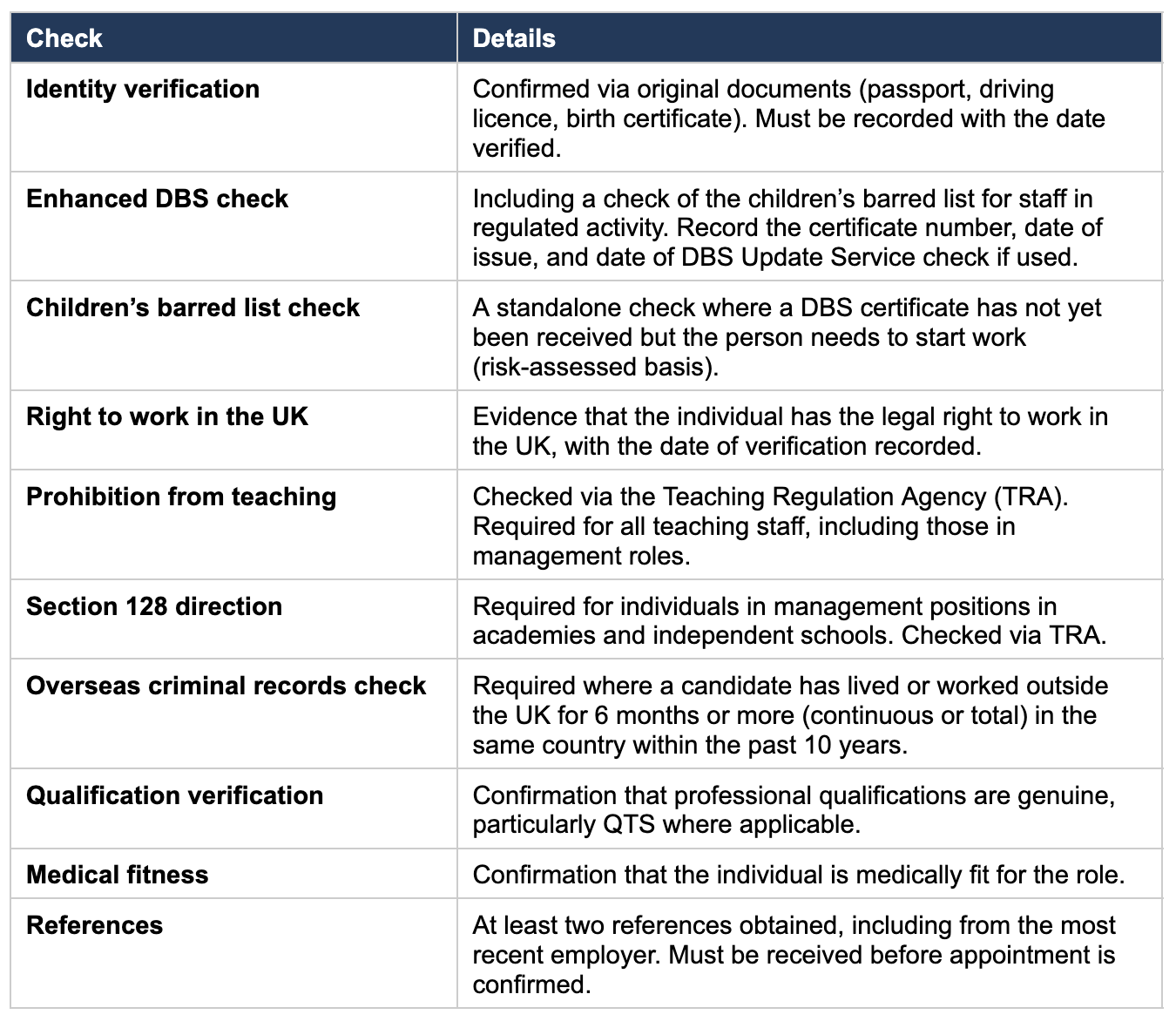
Who Must Be Included on the SCR?
One of the most common compliance gaps ISI inspectors find is missing categories of people. Your SCR must include:
- All permanent teaching staff, including part-time and peripatetic teachers
- All support staff, including administrative, catering, maintenance, and cleaning staff
- Supply staff and agency workers (with confirmation that the agency has carried out the required checks)
- Governors and members of the proprietor body
- Volunteers engaged in regulated activity
- Any contractor or visitor who has unsupervised access to pupils on a regular basis
A common mistake is to exclude peripatetic music teachers, sports coaches, or long-term contractors on the assumption that they are “not really staff.” If they have regular, unsupervised contact with pupils, they must be on the SCR.
Common ISI Inspection Failures and How to Avoid Them
Based on published ISI inspection reports and sector guidance, these are the most frequently identified compliance failures related to the Single Central Record:
Missing or Incomplete Dates
Every check on your SCR must include the date it was completed. A tick or a “yes” without a corresponding date is not compliant. Inspectors are specifically trained to look for this, and it is one of the fastest ways to trigger a regulatory finding.
Gaps in Overseas Checks
Independent schools often employ staff from overseas, yet overseas criminal records checks remain one of the most commonly missed items. Under KCSIE 2025, if a staff member has lived or worked outside the UK for six months or more in any single country within the past ten years, an overseas check is required. This applies even if the person is a British citizen who spent time abroad.
Failure to Update the SCR When Staff Leave or Change Roles
The SCR is a living document. When a member of staff leaves, their record should be retained but clearly marked. When someone changes role, for example, moving from a teaching position to a management position, additional checks such as a Section 128 direction check may be required. Failing to update the SCR to reflect role changes is a compliance gap that inspectors are increasingly looking for.
Over-Reliance on the DBS Update Service Without Proper Recording
Using the DBS Update Service is perfectly acceptable, but inspectors expect to see the date of each status check recorded on the SCR, along with confirmation that the original certificate was seen. Simply noting that a staff member is “registered with the Update Service” is not sufficient.
Practical Steps to Prepare for an ISI Inspection in 2026
Getting your SCR inspection-ready does not need to be overwhelming. Here is a practical checklist your school can follow:
- Conduct a full SCR audit now. Go through every entry and check that all required fields are complete, dated, and attributable to a named person. Do not wait until you receive notice of an inspection.
- Cross-reference against recruitment files. Select ten staff members at random and verify that every check recorded on the SCR is supported by documentary evidence in their personnel file. This is exactly what inspectors will do.
- Review your categories of staff. Ensure that governors, volunteers, peripatetic teachers, supply staff, and long-term contractors are all included. If in doubt, include them.
- Check overseas staff records. Identify any staff member who has lived or worked abroad and confirm that the appropriate overseas criminal records check has been obtained and dated.
- Ensure your SCR is immediately accessible. Whether your SCR is a spreadsheet, a database, or specialist software, make sure it can be produced instantly when an inspector asks for it. Delays in producing the SCR create an immediately negative impression.
- Designate a responsible person. Ensure there is a named individual who is responsible for maintaining the SCR and can answer questions about it during an inspection. This person should understand the regulatory requirements and be able to explain any entries.
- Schedule regular reviews. Implement termly SCR audits as a minimum. Best practice is to review the SCR monthly and after every new appointment or departure.
The Cost of Getting It Wrong
An SCR failure during an ISI inspection is not simply an administrative inconvenience. If inspectors determine that your school does not meet Part 4 of the Independent School Standards, this triggers a formal regulatory finding. Your school may be required to submit an action plan to the DfE, face a follow-up inspection within a shortened timeframe, or in serious cases, face restrictions on its registration.
Beyond the regulatory consequences, there is a reputational dimension. Inspection reports are published publicly, and parents increasingly check inspection outcomes before choosing a school. A finding related to safeguarding or staff suitability can have a material impact on admissions and trust.
How SCR Software Can Help
Many independent schools still manage their SCR using spreadsheets. While this is not prohibited, spreadsheets carry inherent risks: they are easy to edit without an audit trail, they cannot automate reminders for expiring checks, and they make cross-referencing against recruitment files a manual and time-consuming process.
Dedicated SCR software addresses these challenges by providing a structured, auditable, and always-accessible record. Features such as automated DBS Update Service checks, expiry alerts, and centralised document storage mean that when an inspector walks through the door, your SCR is ready.
At School SCR, we work with independent schools and multi-academy trusts across England and Wales to ensure their Single Central Record is always inspection-ready. If you’d like to see how our software can support your compliance, book a free trial.
Key Takeaways
- The SCR is now reviewed at the very start of ISI inspections, there is no time for last-minute fixes.
- Inspectors will cross-reference your SCR against recruitment files, so every entry must be backed by evidence.
- All checks must be dated and attributed to a named person.
- Overseas checks, peripatetic staff, and role changes are the most common compliance gaps.
- Regular auditing and dedicated SCR software are the most effective ways to stay compliant.
The 2026 ISI inspection changes are not a cause for alarm, but they are a clear signal that the bar for SCR compliance is continuing to rise. Schools that invest in getting their records right now will be well-positioned when inspectors come calling.